Articles with tag: "antenna"

(Note: figures do not appear in the summaries below)
  1. NACA-RM-E7H26a

    "The current use of improved airplane ice-prevention equipment has extended operations in icing conditions and thus accentuated the need for protecting aircraft antennas against structural failures resulting from ice accretions"

    "Determination of Aircraft Antenna Loads Produced by Natural Icing Conditions" 1
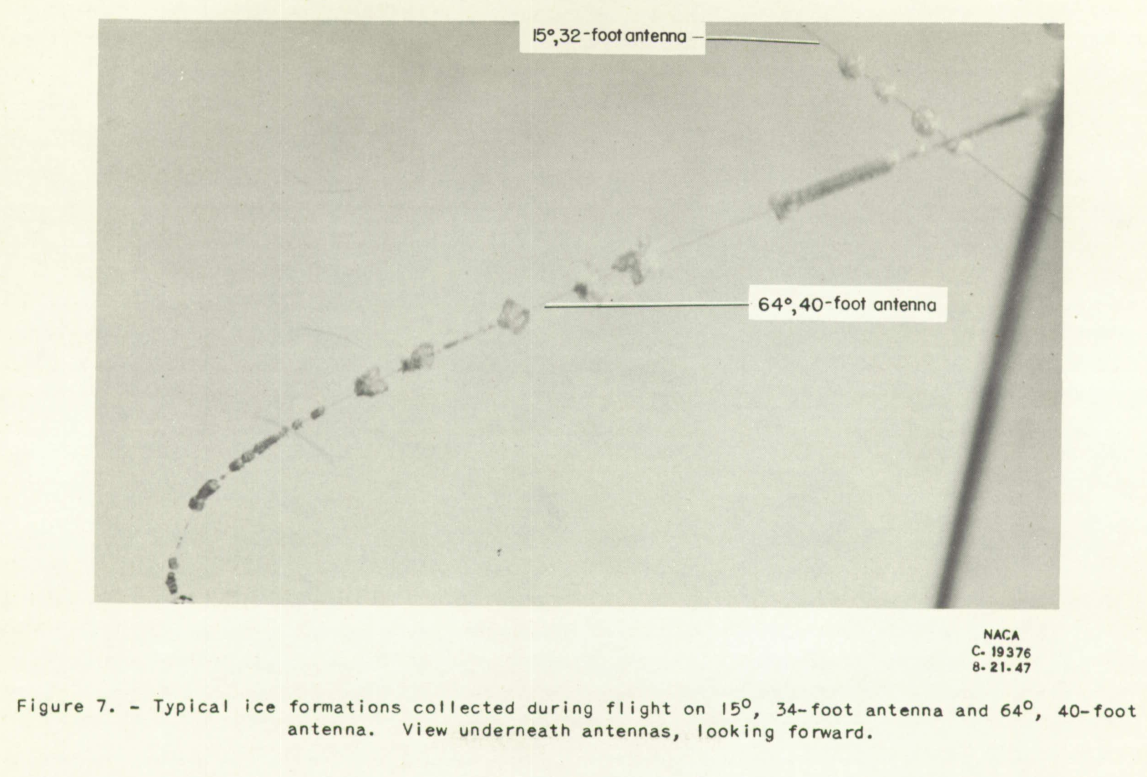
    Figure 7. Typical ice formation collected during flight on 15°, 34-foot antenna and the
64°, 40-foot antenna. View underneath antennas, looking forward.

    Abstract

    A flight investigation was made to determine the effect of distance flown in the icing region, antenna length, and antenna angle on the tension occurring in aircraft antennae while in regions of aircraft icing.

    The, experimental antennas were of lengths ranging from 15 to 43 feet and were placed at angles of 0° to 64° with the airplane thrust axis. Distances up to 256 miles were flown in diverse icing conditions at true airspeeds from 157 to 214 miles per hour and pressure altitudes at which icing conditions were encountered.

    The results indicate that: The effect of ice formation on antenna tension increased with the angle of the …
    read more
  2. NACA-RM-SE9D20

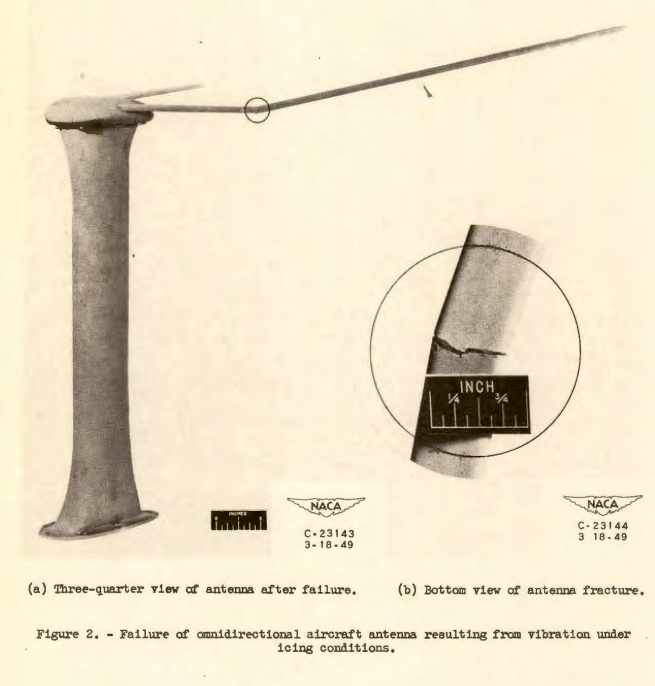
    "After 7 minutes of icing, however, one antenna element experienced a vibratory failure"

    "Vibration and Investigation of CAA Type V-I09 Very-High-Frequency Aircraft Antenna" 1

    Figure 2. Failure at omnidirectional aircraft antenna resulting from vibration under
icing conditions.

    Abstract

    Vibration and icing determinations on a CAA type V-109 very- high-frequency aircraft antenna were conducted in the NACA Lewis icing research tunnel. The antenna is an omnidirectional-range unit that consists of two aluminum elements mounted in a streamline plastic head forming a V in plan view with an apex angle of 80°.

    Vibration determinations during a nonicing experiment produced element-tip total amplitude of approximately 1/4 inch at a tunnel-air velocity of 300 miles per hour.

    During the icing investigation, a total amplitude as great as 7 inches was observed at the antenna-element tips with tunnel-air velocities greater than 160 miles per hour and a tunnel-air temperature of 20° F. At the higher tunnel-air temperatures, which produced a heavier and more severe ice accretion, the …

    read more