Articles with tag: "air jets"

(Note: figures do not appear in the summaries below)
  1. NACA-RM-E55E17a

    "rain deflection by jet blast appears feasible for flight speeds"

    "Preliminary Data on Rain Deflection from Aircraft Windshields by Means of High Velocity Jet-Air Blast" 1
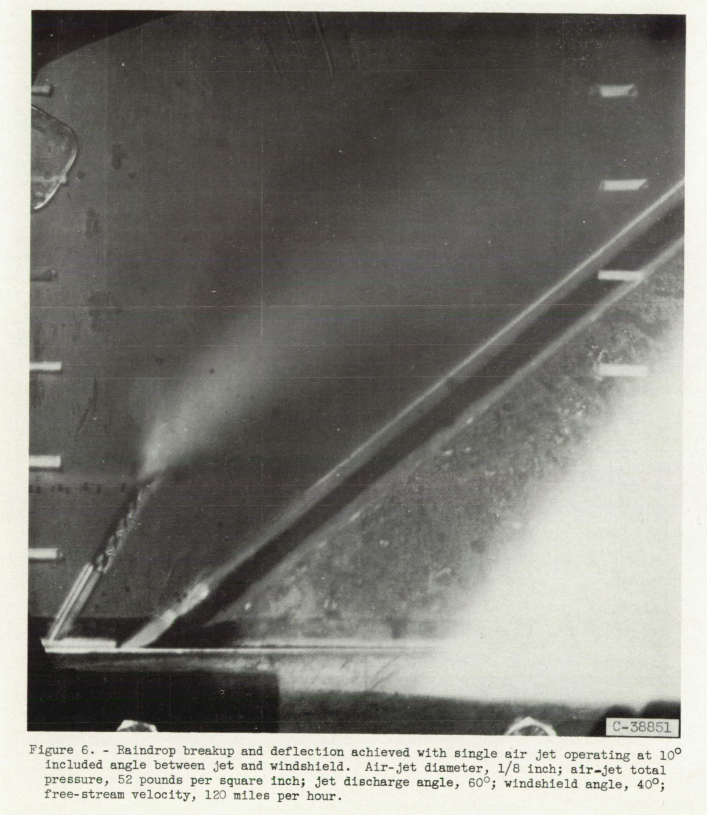
    Figure 6. Raindrop breakup and deflection achieved with single air jet operating at 10°
included angle between jet and windshield. Air-jet diameter, 1/8 inch; air—jet total
pressure, 52 pounds per square inch; jet discharge angle, 60°; windshield angle, 40°;
free-stream velocity, 120 miles per hour.

    Abstract

    A preliminary experimental investigation is being conducted to determine the feasibility of preventing rain from impinging on aircraft windshields by means of high-velocity jet-air blast.

    The results indicate that rain deflection by jet blast appears feasible for flight speeds comparable with landing and take-off speeds of interceptor-type jet aircraft; however, attainment of good visibility through the mist generated by raindrop breakup presents a problem. For the simulated windshield and the lower windshield angles used in the investigation, air-flow rates of the order of 3.3 pounds per minute of unheated air per inch of windshield span were required for adequate rain deflection at a free-stream velocity of 135 miles per hour.

    A method has been devised whereby it is possible to produce large-diameter …
    read more
  2. NACA-TN-2855

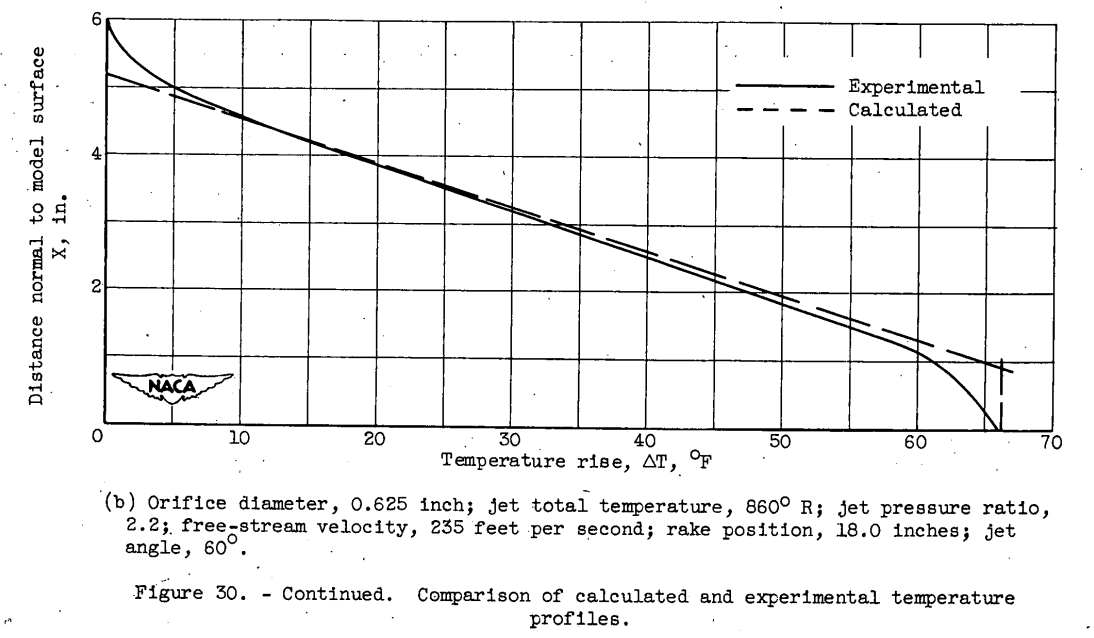
    "For practical application ... the discharging of heated jets into an air stream requires knowledge of the temperature profiles downstream of the heated jet and of the depth of penetration"

    "General Correlation of Temperature Profiles Downstream of Heated Air Jet Directed at Various Angles to Airstream" 1

    Figure 30b. Comparison of calculated and experimental temperature profiles.

    Abstract

    An experimental investigation was conducted to determine the temperature profiles downstream of heated air jets directed at angles of 90°, 60°, 45°, and 30° to an air stream. The profiles were determined at two positions downstream of the jet as a function of jet diameter, jet density, jet velocity, free-stream density, free-stream velocity, jet total temperature, orifice flow coefficient, and jet angle. A method is presented which yields a good approximation of the temperature profile in terms of the flow and geometric conditions.

    Discussion

    INTRODUCTION

    The discharging of heated high-velocity jets of air or vapor into an air stream is employed in many …

    read more
  3. NACA-TN-2019

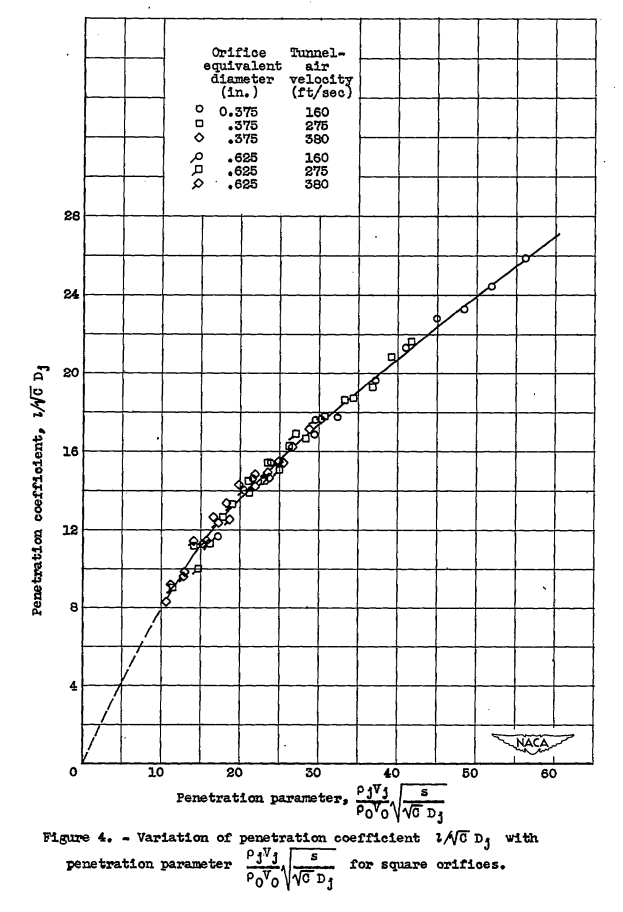
    "square orifices ... provided that a jet dimension equal to the diameter of the equivalent area circle was used"

    "Penetration of air jets issuing from circular, square, and elliptical orifices directed perpendicularly to an air stream" 1

    Figure 4. Variation of penetration coefficient L / C^0.5 Dj with penetration parameter for square orifices.

    Abstract

    An experimental investigation was conducted to determine the penetration of air jets directed perpendicularly to an air stream. Jets issuing from circular, square, and elliptical orifices were investigated and the jet penetration at a position downstream of the orifice was determined as a function of jet density, jet velocity, air-stream density, air-stream velocity, effective jet diameter, and orifice flow coefficient. The jet penetrations were determined for nearly constant values of air-stream density at three tunnel-air velocities and for a large range of jet velocities and densities. The results were correlated in terms of dimensionless parameters and the penetrations of the various shapes were compared.

    Greater penetration was obtained with the square orifices and …

    read more
  4. NACA-TN-1615

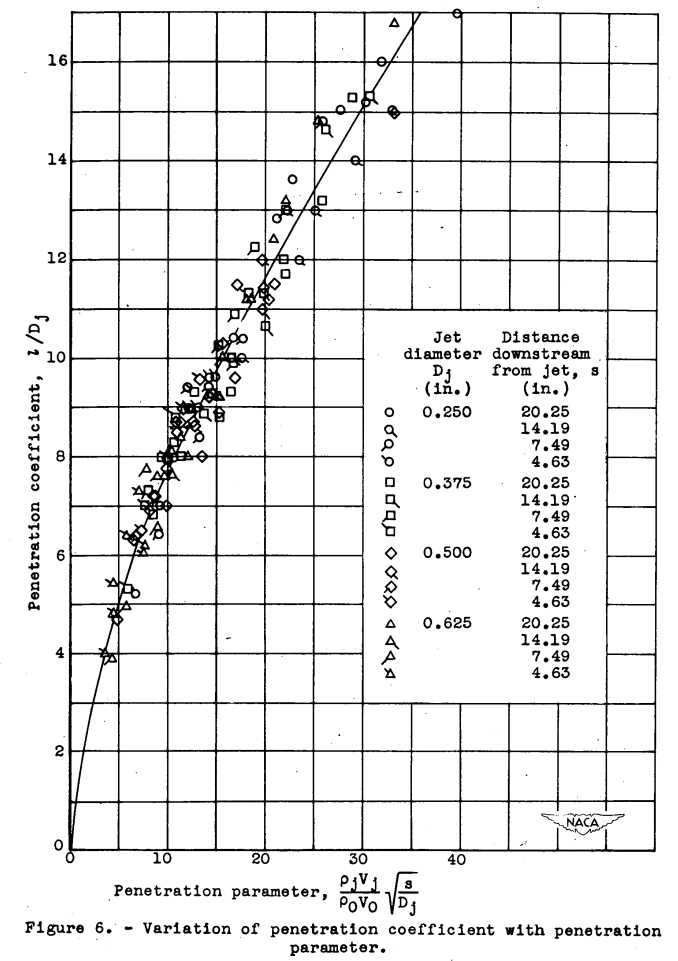
    "it was necessary to define the penetration as the point at which the temperature is 1° F above the free-stream total temperature"

    "Investigation of the Penetration of an Air Jet Directed Perpendicularly to an Air Stream" 1

    Figure 6. Variation of penetration coefficient with penetration parameter.

    An experimental investigation was conducted to determine the penetration of a circular air jet directed perpendicularly to an air strewn as a function of jet density, jet velocity, air-stream density, air-stream velocity, jet diameter, and distance downstream from the jet. The penetration was determined for nearly constant values of air-stream density at two tunnel velocities, four jet diameters, four positions downstream of the jet, and for a large range of jet velocities and densities. An equation for the penetration was obtained in terms of the jet diameter, the distance downstream from the jet, and the ratios of jet and. air-stream velocities and densities.

    Discussion

    INTRODUCTION The introduction of a gas or vapor into …

    read more
  5. NACA-TN-1947

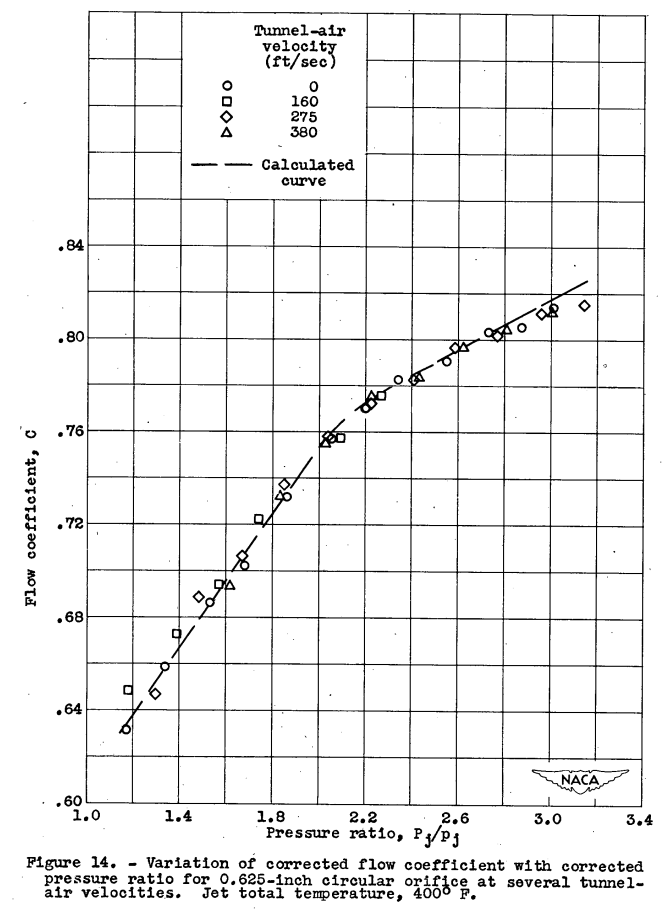
    "Excellent correlation was obtained between the results for a jet discharging into still air and ... into a moving air stream"

    "Investigation of Flow Coefficient of Circular, Square, and Elliptical Orifices at High Pressure Ratios" 1

    Figure 14. Variation of corrected flow coefficient with corrected
pressure ratio for 0.625-inch circular orifice at several tunnel-
air velocities. Jet total temperature, 400 F.

    Abstract

    An experimental investigation has been conducted to determine the orifice coefficient of a jet directed perpendicularly to an air stream as a function of pressure ratio and jet Reynolds number for circular, square, and elliptical orifices. The effect of air-stream velocity on the jet flow was also determined for three tunnel-air velocities. Equations for the flow coefficients In terms of jet Reynolds number and pressure ratio were obtained for the various shapes. Excellent correlation was obtained between the results for a jet discharging into still air and the results for a jet discharging into a moving air stream, provided that the correct outlet pressure was used.

    Discussion

    INTRODUCTION The introduction of a gas or …

    read more
  6. Air Jets

    Published: Mon 04 November 2024
    Updated: Mon 12 January 2026

    tags: air jets

    "rain deflection by jet blast appears feasible for flight speeds"

    Figure 6 of NACA-RM-E55E17a. Raindrop breakup and deflection achieved with single air jet operating at 10°
included angle between jet and windshield. Air-jet diameter, 1/8 inch; air—jet total
pressure, 52 pounds per square inch; jet discharge angle, 60°; windshield angle, 40°;
free-stream velocity, 120 miles per hour.
    From NACA-RM-E55E17a.

    Introduction

    Five of these publications are from the "Jet Penetration" section, and one is from the "Windshield Ice Protection" section of The Historical Selected Bibliography of NACA-NASA Icing Publications.

    The first five publications determine by test the characteristics of air jets entering a moving airstream. The final publication applies this technology to windshield rain removal.

    Windshield rain removal is often designed in the same group as ice protection. SAE AIR-1168/4 is titled “Ice, Frost, and Rain Protection” [SAE Aerospace Applied Thermodynamics Manual, 1969 (regularly updated, currently document sae.org)]. A design group I worked in was named "Ice and Rain Protection".

    That was historically where the knowledge of water drops, air flow control, and mechanical systems resided.

    So, it is not surprising that a rain-removal publication is in the "Selected Bibliography of NACA-NASA Aircraft Icing Publications".

    Air …

    read more